By Julian Osamoto
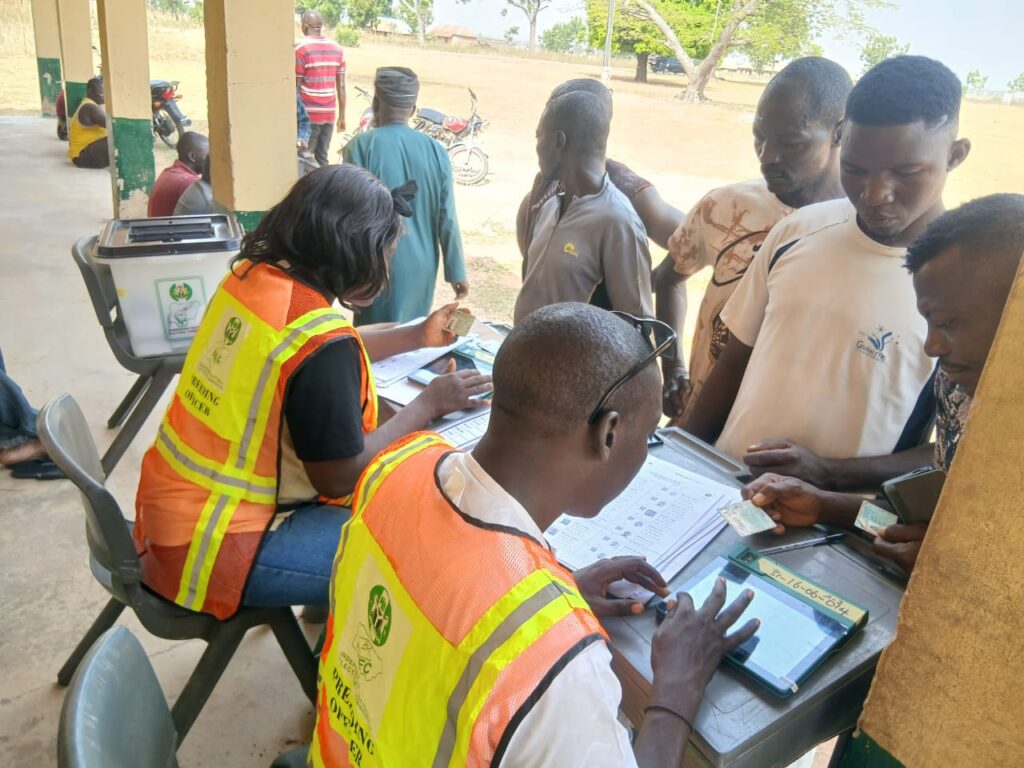
The Kimpact Development Initiative (KDI) has reported 202 cases of biometric accreditation failure during the Independent National Electoral Commission’s (INEC) nationwide mock accreditation and results-upload exercise ahead of the 2027 general elections.
The reported failures involved fingerprint verification and facial recognition, raising concerns about the reliability and operational efficiency of the Bimodal Voter Accreditation System (BVAS) ahead of the elections.
In its preliminary statement released on Saturday, KDI says it deployed 185 observers across selected polling units in all 109 senatorial districts and the six geopolitical zones to assess BVAS performance, biometric accreditation and the upload of simulated election results to INEC’s Results Viewing Portal (IReV).
The organisation said it received 1,300 observer reports as of 1 p.m., including 1,245 reports on biometric accreditation. Of these, 879, representing 70.6 per cent, indicated that accreditation was completed within one minute, while the remaining 29.4 per cent took longer.
Of the 202 reported biometric failures, fingerprint verification accounted for 108 cases, representing 53.47 per cent, while facial recognition accounted for 94 cases, or 46.53 per cent.
KDI said its observers recorded instances where facial recognition provided an alternative when fingerprint verification failed. However, there were also cases where facial recognition failed without fingerprint verification successfully resolving the accreditation challenge.
The organisation explained that BVAS-related challenges were reported across all six geopolitical zones, with the South West accounting for the highest share at 25.25 per cent, followed by the North East with 22.77 per cent and the North West with 21.29 per cent.
The North Central accounted for 15.84 per cent, the South South 11.39 per cent and the South East 3.47 per cent. KDI clarified that the figures represented the distribution of reported challenges across its monitored locations and should not be interpreted as regional failure rates.
BVAS delays were the most frequently reported operational challenge, accounting for 46.05 per cent of recorded problems. Other issues included system malfunctions at 18.42 per cent, card and data mismatches at 13.16 per cent, network problems at 7.89 per cent and malpractice or voter participation concerns at 6.58 per cent.
Device configuration and application errors accounted for 5.26 per cent, while battery-related problems represented 2.63 per cent of the reported challenges.
The report also showed that individuals aged 35 to 44 accounted for 36.14 per cent of reported accreditation challenges, followed by those aged 45 to 59 at 29.70 per cent. Together, the two age groups represented 65.84 per cent of the cases reflected in the age distribution.
However, KDI cautioned that the figures did not establish that biometric accreditation failure was more likely among voters in those age groups.
On public awareness, the organisation reported that some prospective participants were unclear about the objectives and procedures of the mock exercise.
In Umuoji Ward, Idemili North Local Government Area of Anambra State, some prospective participants reportedly declined to take part because the sample ballot papers used during the exercise did not contain the names of political parties.
KDI noted that although the exercise was designed to test accreditation and results-upload systems rather than conduct an actual election, the incident highlighted the need for better public communication about the purpose and procedures of such exercises.
The organisation also reported that monthly environmental sanitation exercises in Bauchi and Abia States may have affected movement and participation in some locations. In contrast, Lagos State reportedly suspended its sanitation exercise to avoid interfering with INEC’s activities.
KDI consequently urged INEC to investigate the reported biometric accreditation failures, identify corrective measures, improve public sensitisation and strengthen coordination with state authorities ahead of future electoral activities.
It notes that the mock exercise provided an opportunity for INEC and other electoral stakeholders to identify and address operational and technical shortcomings before the 2027 general elections.
The organisation added that its findings were preliminary, based on reports received from monitored locations as of 1 p.m., and did not constitute a comprehensive assessment of all participating polling units.
KDI assured that it would continue analysing reports from its Election Day Data Room and release a more comprehensive assessment incorporating additional observations from the exercise.