Listeners:
Top listeners:
-
play_arrow
104.9FM Best rock music demo
-
play_arrow
Demo Radio Nr.1 For New Music And All The Hits!
-
play_arrow
Demo Radio Techno Top Music Radio
-
 play_arrow
Police Commissioner Launches Weapon and Riot Control Training for FCT Officers Democracy Radio

Nigeria Wastes Innovation Potential Through Poor Coordination — Minister Udeh
By Julian Adetinuyo
The Minister of Innovation, Science and Technology, Kingsley Udeh, says Nigeria continues to lose economic value not because it lacks ideas or skilled people, but due to its inability to turn innovation into industries, jobs and competitive products.
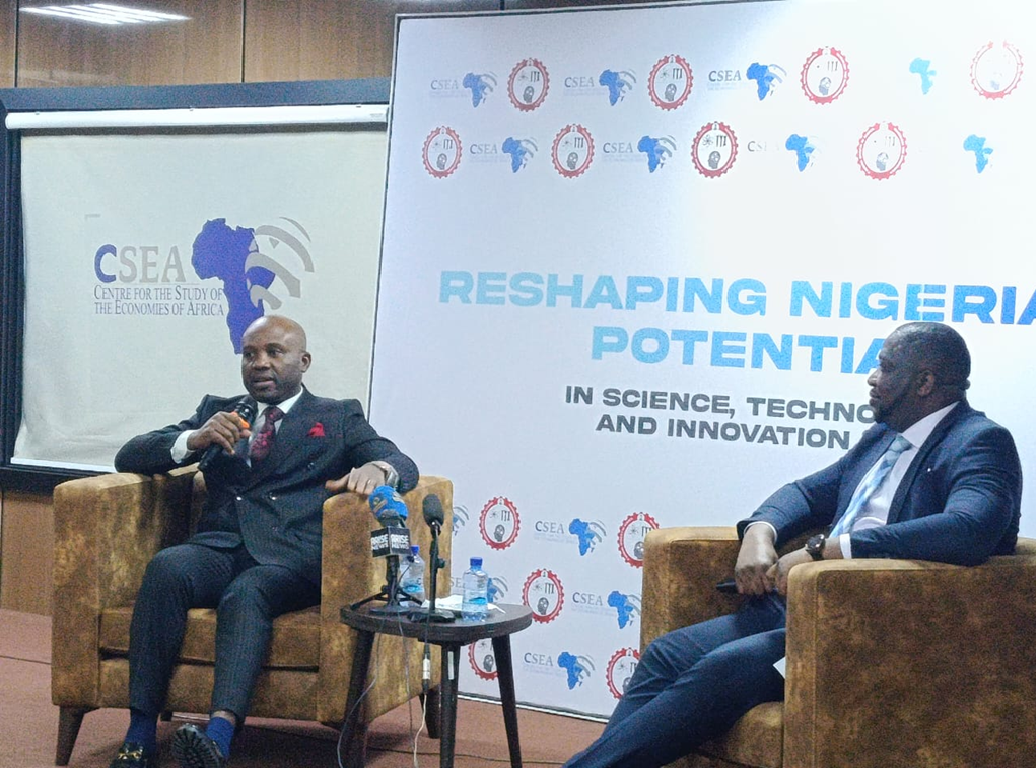
Udeh made this assertion during a fireside chat organised by the Centre for the Study of the Economies of Africa (CSEA) in Abuja, where he challenged Nigeria to confront a long-standing structural weakness in its development model.
He said despite abundant natural resources and a globally respected talent pool, Nigeria has remained stuck as a raw-material exporter and consumer economy due to a broken innovation pipeline.
According to the minister, the core problem lies in the disjointed nature of Nigeria’s science, technology and innovation (STI) ecosystem, where government agencies, researchers, private investors and innovators work independently rather than as a coordinated system.
“Nigerians drive innovation across the world, from advanced engineering to space technology. At home, the system fails them. What is missing is coordination, focus and an ecosystem that converts research into products,” Udeh stated.
Government Targets Structural Gaps
Udeh said the Federal Government has began addressing these gaps under President Bola Tinubu’s Renewed Hope Agenda by redefining science, technology and innovation as an economic engine rather than a policy afterthought.
He disclosed that his ministry is finalising a national STI roadmap designed to align research priorities with national development goals and market demand, while forcing stronger collaboration across institutions.
“As part of the shift, the National Office for Technology Acquisition and Promotion (NOTAP) has expanded its role beyond patent registration to active support for prototyping, product development and commercialisation”.
“Issuing patent certificates without market pathways adds no value. Innovation must end in production and jobs,” he said.
30% Value Addition Law to End Raw Exports
The Minister noted that the newly passed 30 per cent value-addition bill represents a decisive break from Nigeria’s long-standing dependence on exporting unprocessed raw materials.
The legislation requires exporters of minerals and agricultural produce, including cocoa and cassava, to carry out at least 30 per cent local processing before shipment.
According to him, the policy will stimulate manufacturing, expand domestic value chains and retain wealth within the country.

“Value addition cannot happen by decree alone. That is why the law includes incentives, infrastructure support and a moratorium period for capacity building,” he said.
Satellites to Power Intelligence-Led Security
On national security, the minister revealed that the Federal Executive Council has approved the launch of four new satellites, three optical and one Synthetic Aperture Radar (SAR) to boost surveillance and intelligence gathering.
He said the ministry is already working with the Ministry of Defence and the Armed Forces to integrate satellite-generated geospatial data into security operations nationwide.
“Our responsibility is to provide the science and technology backbone that enables informed security decisions,” Udeh said.
Innovation Hubs Under Review
Udeh acknowledged that Nigeria operates 52 technology incubation hubs and 68 intellectual property and technology transfer centres, but admitted many have failed to deliver impact.
He said the ministry has begun a performance review to reposition the facilities as functional bridges between research institutions, industry and entrepreneurship.
Solar Push Signals Energy Transition
On energy diversification, Udeh said the Energy Commission of Nigeria is driving a solarisation programme that is moving universities and hospitals off the national grid.
He added that the government is also developing local capacity to manufacture solar components and train technicians, reducing dependence on imported technology.
Experts Warn of Lost Generations
In a keynote address, former Director-General of the Raw Materials Research and Development Council, Prof. Azikiwe Onwualu, warned that Nigeria risks falling far behind if it fails to fix its innovation system.
He identified weak academia–industry linkages, poor funding structures, infrastructure deficits and brain drain as major constraints.
“Talent does not build nations. Systems do. Research must create goods, services and jobs that change lives,” Onwualu said.
He urged the government to urgently activate the National Research and Innovation Fund, strengthen intellectual property protection and prioritise research commercialization.
Earlier, the Executive Director CSEA Dr Chukwuka Onyekwena, said Nigeria’s innovation ambitions would only succeed with sustained investment, strong public-private partnerships and deliberate alignment of research with national and market needs.
The speakers agreed that Nigeria must urgently move from a consumption-driven economy to a production-based, knowledge-led economy, anchored on coordinated investment in science, technology and innovation.