Listeners:
Top listeners:
-
play_arrow
104.9FM Best rock music demo
-
play_arrow
Demo Radio Nr.1 For New Music And All The Hits!
-
play_arrow
Demo Radio Techno Top Music Radio
-
 play_arrow
Police Commissioner Launches Weapon and Riot Control Training for FCT Officers Democracy Radio
Power of Voices: Oxfam, Partners Close Five-Year Climate Justice
By Julian Osamoto
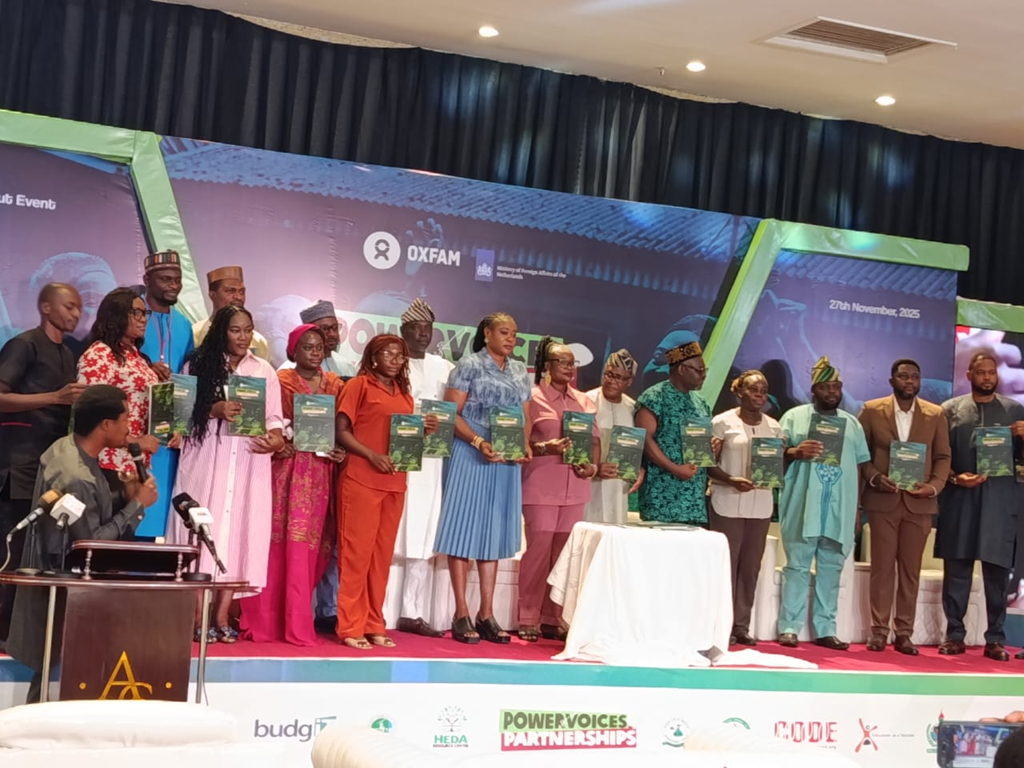
Oxfam Nigeria and a coalition of civil society partners have marked the completion of the Fair for All (F4A) and African Activists for Climate Justice (AACJ) programmes, celebrating five years of transformative interventions in climate justice, governance, civic engagement, and community empowerment across Nigeria.
At the project close-out event in Abuja, Oxfam Country Director John Makina described the programmes as a “five-year journey of courage, partnership, and transformation,” emphasising the power of citizen-led action to drive systemic change.
“We are not simply closing the project; we are celebrating a journey that has shifted power, amplified voices, and placed citizens at the centre of governance, climate justice and economic accountability,” Makina said.
Key Achievements and Impact
Makina highlighted results demonstrating the programmes’ wide-reaching influence:
- Climate Resilience: Over 15,500 seedlings cultivated through community nurseries; 3,500 clean cooking stoves distributed in Bauchi State to reduce emissions and improve women and children’s health.
- Community Empowerment: 256 volunteers trained, including persons with disabilities, in briquette production and climate-smart livelihoods; women earned between N150,000–N300,000 through climate-friendly enterprises.
- Climate Finance:5 billion unlocked at local government levels, expanding access to adaptation resources.
- Governance & Civic Engagement: Establishment of three Host Community Development Trusts (HCDTs); submission of a 10% oil derivation proposal to Akwa Ibom State House of Assembly; over 10 million Nigerians reached through “Follow the Money” radio and TV programmes; civic clubs launched in multiple states with thousands of students engaged.
- Transparency and Accountability: Freedom of Information coalitions formed across five states; 500 journalists trained in climate and environmental reporting; police commitments secured to protect civic space.
“When people are empowered, systems change. When communities speak, institutions listen. And when justice becomes a collective pursuit, transformation becomes inevitable,” Makina added.
He thanked the Government of the Netherlands for funding, and recognised implementing partners including CISLAC, CODE, BudgIT, GIFSEP, YMCA, and others.
Speaking for CISLAC, CODE, BudgIT, Digital Delta, and other civil society partners, Auwal Musa Rafsanjani framed the close-out as a critical milestone in Nigeria’s pursuit of transparency, equity, and climate resilience.
“This is not merely a ceremonial closure. It is a moment of reflection, appreciation and renewed commitment to advancing justice, equity and sustainable development for vulnerable communities,” Rafsanjani said.
He highlighted transformative wins under the Fair for All programme:
- Maritime and Trade Sector: $1.048 billion approved by the Federal Government for port rehabilitation and a new export terminal, improving trade corridors and supporting MSMEs, including women-led businesses.
- Tax Justice and Fiscal Reforms: Fair Tax Monitor evidence led to national debate on progressive taxation, review of tax waivers, digitalisation of the tax system, and passage of four new tax laws effective January 2026.
- Transparency & Beneficial Ownership: Strengthened compliance with national ownership registers and debt oversight.
- State-Level Fiscal Governance: 21 State Tax Justice and Governance Platforms established, including Abuja, coordinating reforms and promoting accountability.
- Host Community Development Trusts: National Convergence on HCDTs emerged as a key mechanism to reduce elite capture and strengthen equitable management of statutory 3% allocations under the Petroleum Industry Act (PIA).
- Gender, Youth, Climate & Civic Space: Initiatives mainstreamed inclusion, environmental justice, and protection of civil space.
Rafsanjani stressed sustainability:
“We cannot fold our arms simply because there is no more funding from Oxfam. The work must continue because inequalities persist, fiscal leakages weaken growth, and communities still demand transparency.”
He also praised Oxfam’s approach:
“Unlike some international NGOs that overshadow local organisations, Oxfam empowered local groups to lead development work in their own communities.”
Extractive Sector Transparency Gains
Project partners noted that the National Convergence on HCDTs is now a powerful tool for ensuring transparency and equitable use of statutory 3% allocations to host communities. The platform, supported by collaborations with CODE, BudgIT, KEBETKACHE, and NDEBUMOG, has strengthened community accountability, gender inclusion, conflict sensitivity, and climate justice interventions.
Looking Forward
As the programmes close, partners stressed that sustaining networks, governance structures, and community capacities remains critical to protecting hard-won gains.
Makina concluded, that, “We are not ending the journey. We are opening a new chapter—one where the systems, networks and capacities we have built must continue to grow and strengthen.”
The event also launched a documentary and magazine chronicling the five-year journey, capturing lessons, successes, and community-led innovations.