Listeners:
Top listeners:
-
play_arrow
104.9FM Best rock music demo
-
play_arrow
Demo Radio Nr.1 For New Music And All The Hits!
-
play_arrow
Demo Radio Techno Top Music Radio
-
 play_arrow
Police Commissioner Launches Weapon and Riot Control Training for FCT Officers Democracy Radio
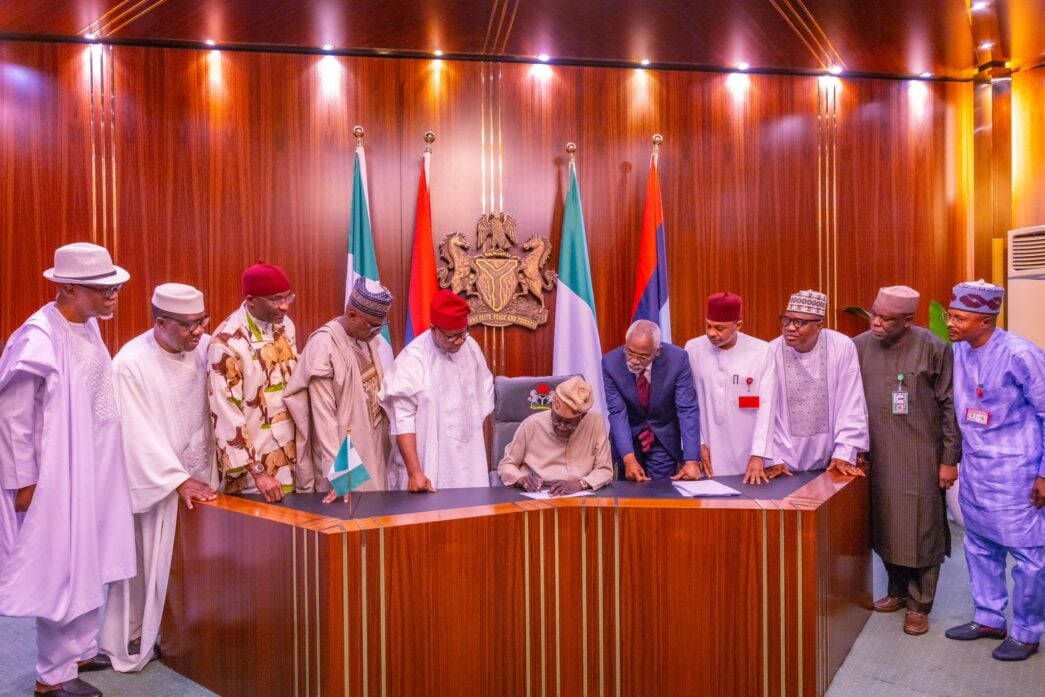
President Tinubu Signs Electoral Act 2026
By Oluwakemi Kindness
President Bola Tinubu has signed the Electoral Act, 2022 (Repeal and Re-Enactment) Bill 2026 into law, following its passage by the National Assembly after months of deliberations.
The signing ceremony took place on Wednesday at the State House, with top government officials in attendance, including Senate President Godswill Akpabio, Speaker of the House of Representatives Tajudeen Abbas, and Chief of Staff to the President, Femi Gbajabiamila.
Speaking at the event, President Tinubu said the essence of democracy lies in robust and sincere discussions that are committed to national development and nation-building, noting that such engagement is critical to the country’s stability.
He stressed that it was time for Nigerians to regain confidence in the electoral system.
According to the President, what matters most is not historical arguments around the process but the effective management of elections to prevent confusion and voter disenfranchisement.
“What is crucial is that you manage the process to the extent that there will be no confusion, no disenfranchisement of Nigerians, and that we are all going to see democracy flourish,” he said.
Addressing debates surrounding the transmission of election results, Tinubu emphasized that human involvement remains central to the electoral process.
He noted that final election results are announced by officials, not computers, and questioned Nigeria’s current and future technical capacity, including broadband infrastructure, to support real-time electronic transmission.
He further explained that voting in Nigeria remains largely manual, from voter accreditation and ballot casting to vote counting and collation.
“Ballots are counted manually, sorted manually, and recorded manually. It is the arithmetic accuracy that goes into Form EC8A. The transmission of that manual result is what we are addressing,” the President said.
Tinubu concluded by reiterating that while systems may evolve, democracy ultimately depends on the people who operate, promote, and validate the process.